Adjustments with Attachments
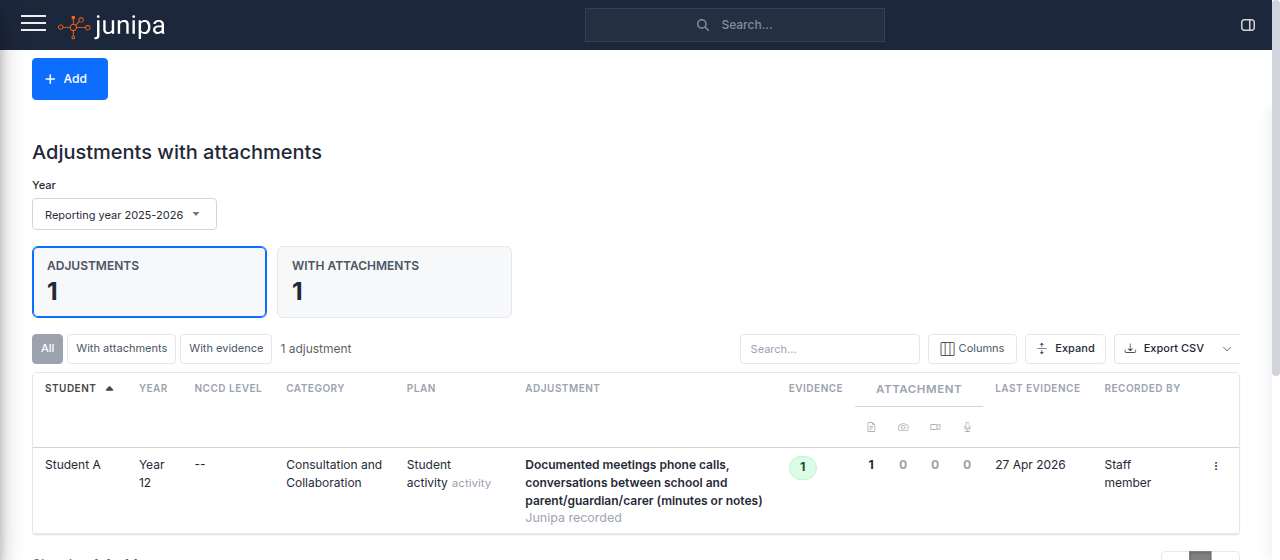
The Adjustments with Attachments report shows whether planned adjustments have supporting files connected to them. It is one of the most useful pre-census reports because it turns an abstract evidence problem into a practical teacher action.
If an adjustment exists but there is no attachment, the next step is clear: find the file, note, work sample or record that shows the adjustment happened.
When to use this report
Use this report when you need to check whether the school can point to proof for the adjustments being recorded.
It helps with questions like:
- Which adjustments have evidence connected?
- Which adjustments have no supporting files?
- Which staff member recorded the adjustment?
- How recently was evidence added?
- Which students need a follow-up before census week?
What the summary tells you
Start with the summary numbers at the top of the report. Compare the total number of adjustments with the number that have attachments.
If the attachment count is lower than expected, do not treat that as a failure. Treat it as a follow-up list. The report is showing where teachers or case managers can make the record stronger.
What to check in each row
| Column | Plain meaning | Teacher action |
|---|---|---|
| Student | The student linked to the adjustment | Open the student record if you need context. |
| Adjustment | The support being provided | Check whether the wording still reflects what happens in class. |
| Evidence | Whether evidence is connected | Add or update the evidence if the support has changed. |
| Attachment | Whether files are connected | Attach the modified task, plan, meeting note, timetable, work sample or image. |
| Last evidence | How recent the supporting record is | Add a recent note if the record is old or no longer clear. |
| Recorded by | The staff member to follow up with | Ask the person closest to the student to confirm the record. |
Examples of useful attachments
Attachments should help another person understand the support without needing a long explanation. Useful attachments include:
- A modified assessment or worksheet.
- A visual schedule, social story or task scaffold.
- A learning plan or behaviour support plan.
- A meeting note from a parent, carer or specialist discussion.
- A timetable showing a regular support arrangement.
- A work sample showing the adjusted task.
- An observation note or image that shows the adjustment in context.
What to say to teachers
Use concrete language. For example:
- "This adjustment says the student receives a modified task. Can you attach the modified task or a work sample?"
- "This record mentions regular check-ins. Can you add the note that shows what changed for the student?"
- "This student has an adjustment but no attachment. What file or example would help another staff member understand the support?"
Before census week
Run this report weekly in the lead-up to census. Each week, focus on the shortest follow-up list you can action.
The strongest pattern is:
- Filter or scan for adjustments without attachments.
- Assign each row to the staff member closest to the evidence.
- Add the supporting file or note.
- Re-open the report and confirm the row has changed.
This gives the school confidence that adjustments are backed by visible proof, not just remembered practice.